I've spent many years working across enterprise software delivery, and I have not seen a shift as significant as the rise of practical AI. For a long time, AI felt like a specialist area reserved for researchers and data scientists. That is no longer the case.
Today, modern developers are expected to do more than build web applications. They are increasingly expected to connect applications with large language models, APIs, retrieval systems, and AI workflows. That is where the idea of an AI Full Stack Engineer becomes important.
In this article, I'll explain what this role means, how it differs from traditional full stack development, and how I would recommend building toward it in 2026.
What is an AI Full Stack Engineer?
An AI Full Stack Engineer is a developer who can build a complete application from frontend to backend, and also integrate AI capabilities into that application. That may include calling LLM APIs, building document-aware search, adding AI-powered summaries, or designing multi-step workflows that use tools and data.
I do not see this as a completely new job title that replaces full stack development. I see it as the next evolution of full stack development. The foundation is still software engineering. AI simply adds a new layer on top of the stack.
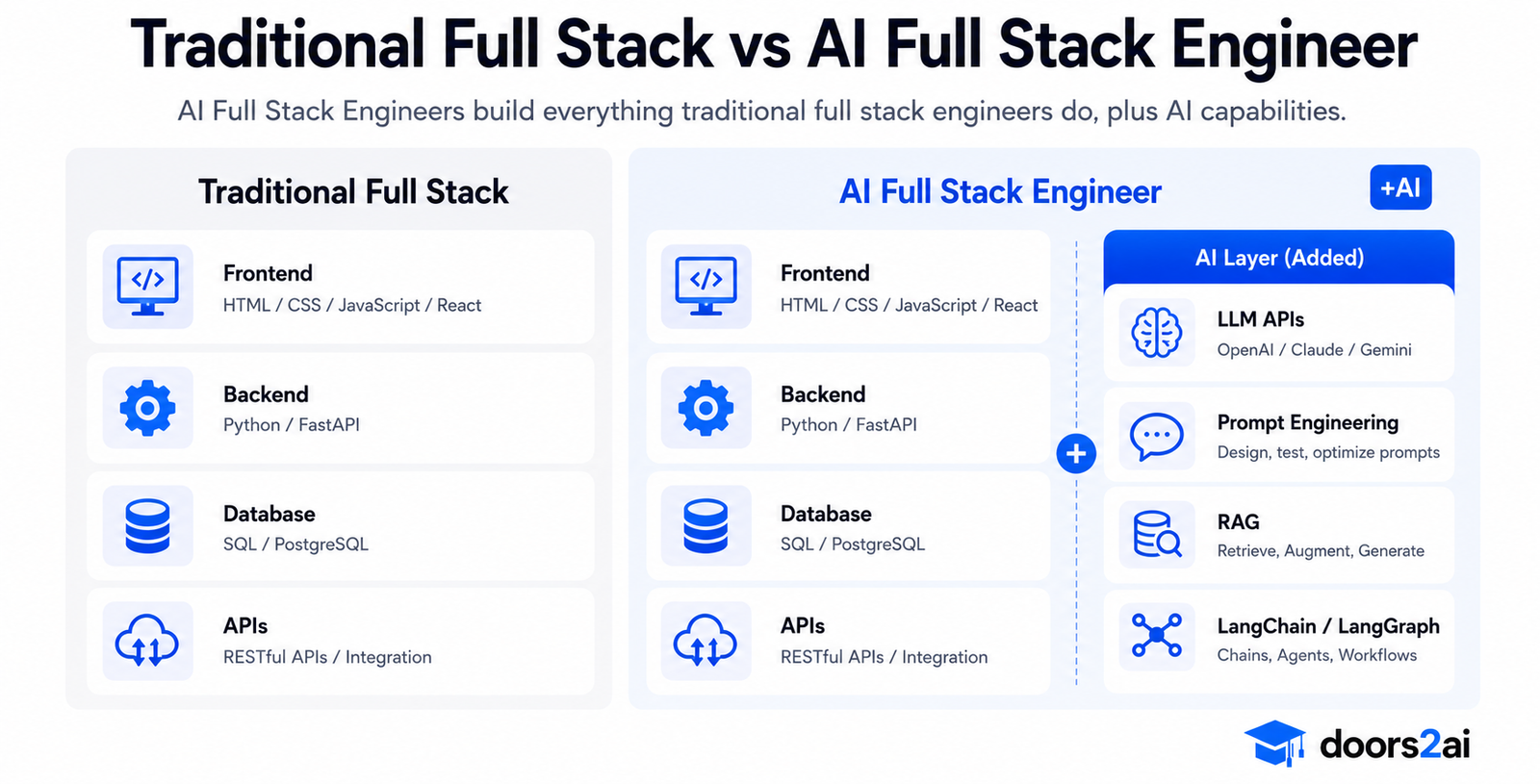
How this role differs from a traditional full stack developer
A traditional full stack developer works across the frontend, backend, database, APIs, and deployment. Those skills still matter. In fact, they matter even more when AI enters the picture.
The difference is that an AI Full Stack Engineer also understands how to:
- Call and work with LLM APIs such as OpenAI, Claude, or Ollama
- Write prompts that produce structured and reliable outputs
- Use retrieval-augmented generation (RAG) for document-aware features
- Build AI workflows using tools such as LangChain or LangGraph
- Connect AI outputs back into real application logic and user experience
AI does not remove the need for strong engineering fundamentals. It exposes weak fundamentals very quickly. If your APIs, data flow, error handling, and backend design are not solid, adding AI will usually make the system harder to manage.
Core skills you will need
Frontend fundamentals
You do not need to be a design expert, but you do need to understand how users interact with your application. HTML, CSS, and JavaScript remain the foundation. React and Next.js are useful for modern frontend work, especially when you want to build portfolio-ready applications.
Backend development
For AI application development, Python is a practical choice because much of the AI ecosystem is built around it. FastAPI is especially useful because it lets you build clean APIs that connect your frontend, database, and AI services.
Databases and data flow
Most useful applications need to store and retrieve data. SQL and PostgreSQL are still worth learning because they teach you how real application data is structured. Later, when you work with RAG, you can add vector databases and embeddings on top of that foundation.
APIs and integration
AI applications depend heavily on APIs. You will call model APIs, expose your own backend APIs, and connect external services. In my experience, developers who are comfortable with HTTP, authentication, request-response flows, and error handling move much faster when learning AI integration.
LLM foundations and prompting
You do not need to train a language model. But you do need to understand how to use one responsibly: how prompts affect outputs, why responses can vary, how to request structured data, and how to handle cases where the model gives an incomplete or unreliable answer.
RAG and AI workflows
RAG allows an AI application to answer based on your own documents or data instead of relying only on the model's training. Tools like LangChain and LangGraph help you organize multi-step workflows, manage state, call tools, and build more reliable AI-powered features.
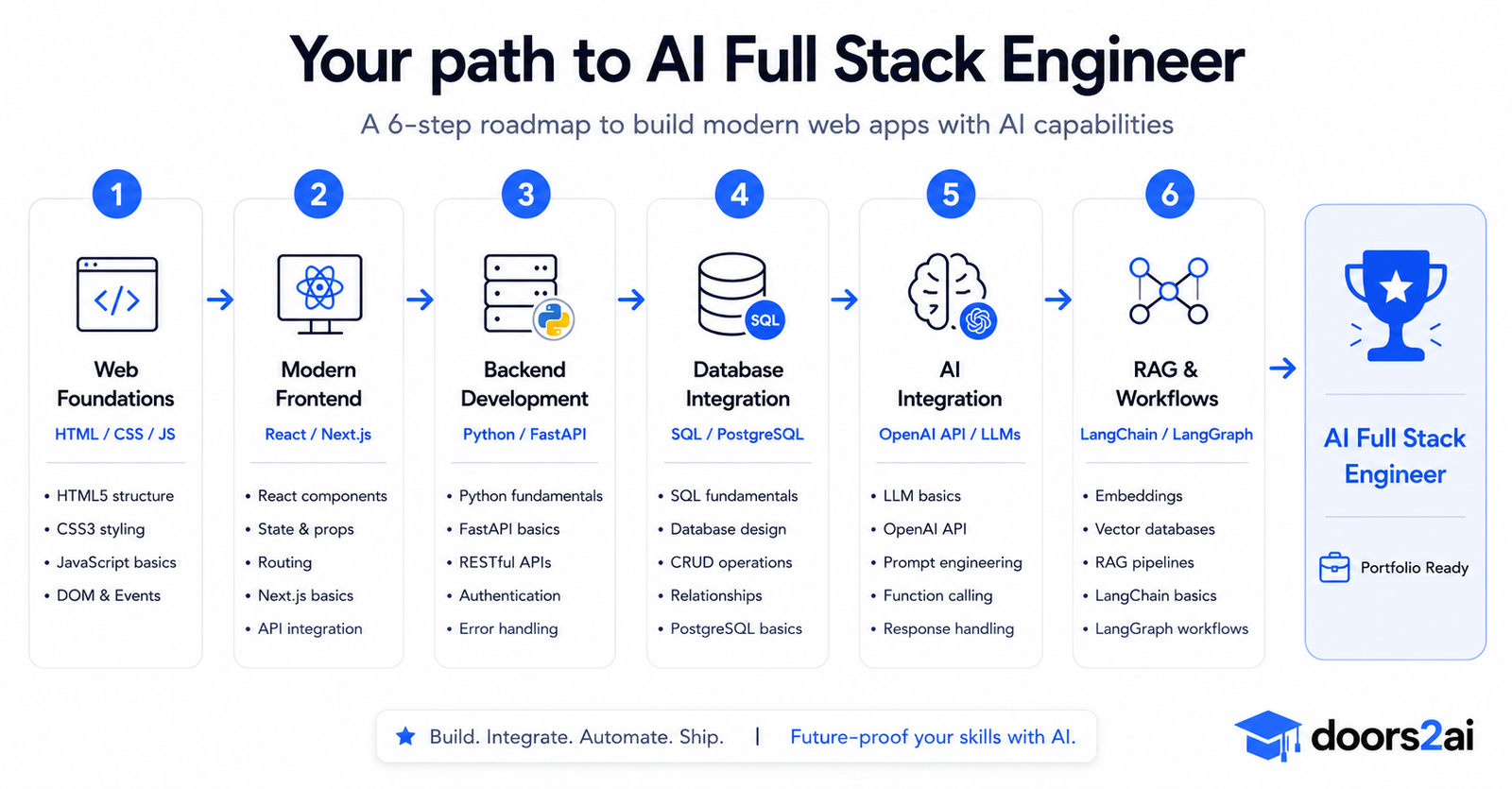
A suggested learning roadmap
If I were advising a beginner, I would not recommend jumping straight into agents or advanced frameworks. I would build the stack one layer at a time:
- Web foundations — HTML, CSS, JavaScript, and basic responsive design.
- Modern frontend — React, Next.js, components, routing, and simple user interfaces.
- Backend development — Python, FastAPI, REST APIs, and basic authentication.
- Database integration — PostgreSQL, SQL fundamentals, and backend-to-database connections.
- AI integration — Call an LLM API and build a simple AI feature such as a chatbot, summariser, or classifier.
- RAG and workflows — Build a document-aware feature and then add structured workflows using LangChain or LangGraph.
This order matters. Each stage makes the next one easier. Skipping ahead may feel faster, but it usually creates gaps that show up later.
Common mistakes I see beginners make
Skipping the fundamentals
AI is exciting, so it is natural to want to start there. But if you are not comfortable with APIs, databases, and backend logic, AI integration becomes much harder. The strongest AI developers I see are still strong software developers first.
Treating prompts as magic
Prompting matters, but reliable AI applications need more than good prompts. You need output validation, fallback logic, clear user flows, error handling, and a plan for what happens when the model gives an unexpected response.
Reading without building
It is easy to watch tutorials and feel like you understand the stack. Real understanding comes when you build something, hit errors, debug them, and improve the design. Small projects are better than endless theory.
Ignoring deployment and security
Running locally is only the beginning. You also need to understand environment variables, API key security, basic hosting, and how your application behaves outside your laptop.
Practical projects to build
If you want to build confidence, I would start with projects that connect multiple layers of the stack:
- AI chatbot with a backend API — a simple frontend, FastAPI backend, and LLM API integration.
- Document Q&A tool — upload documents, create embeddings, retrieve relevant content, and answer questions using RAG.
- AI workflow assistant — use LangGraph to process user input through multiple steps and return structured output.
These projects are not just portfolio pieces. They teach you how the frontend, backend, database, APIs, and AI layer work together.
Key takeaways
- AI Full Stack Engineering is an evolution of full stack development, not a replacement for it.
- Strong fundamentals in frontend, backend, databases, and APIs still matter.
- LLM APIs, prompting, RAG, and workflows are the new AI layer on top of the stack.
- The best way to learn is to build small, complete applications.
- Do not rush into advanced tools before you understand the basic application architecture.
Final thoughts
I believe the AI Full Stack Engineer will become one of the most practical developer profiles over the next few years. Not because every developer needs to become an AI researcher, but because more applications will include AI features as a normal part of the product.
My advice is simple: build the foundation first, then add AI one layer at a time. If you can connect a frontend, backend, database, API, and LLM into one working application, you are already ahead of many beginners trying to learn this space.
If you want a structured, project-based path into full stack and AI application development, the doors2ai learning paths are designed to take you from foundations through to building real AI-powered applications — with live instruction and guided projects at every stage.