Most developers start with AI in a simple way: write a prompt, send it to a language model, get a response, and display the answer. That is useful, but it is not the same as building an AI application.
From my experience working on enterprise software and AI-enabled applications, the bigger opportunity is not just using an LLM. It is designing systems where the LLM can work with tools, data, workflows, and application logic. That is where Agentic AI becomes important.
In this article, I will explain what Agentic AI means, why it matters for developers, and what I would focus on if I were learning this skill today.
What is Agentic AI?
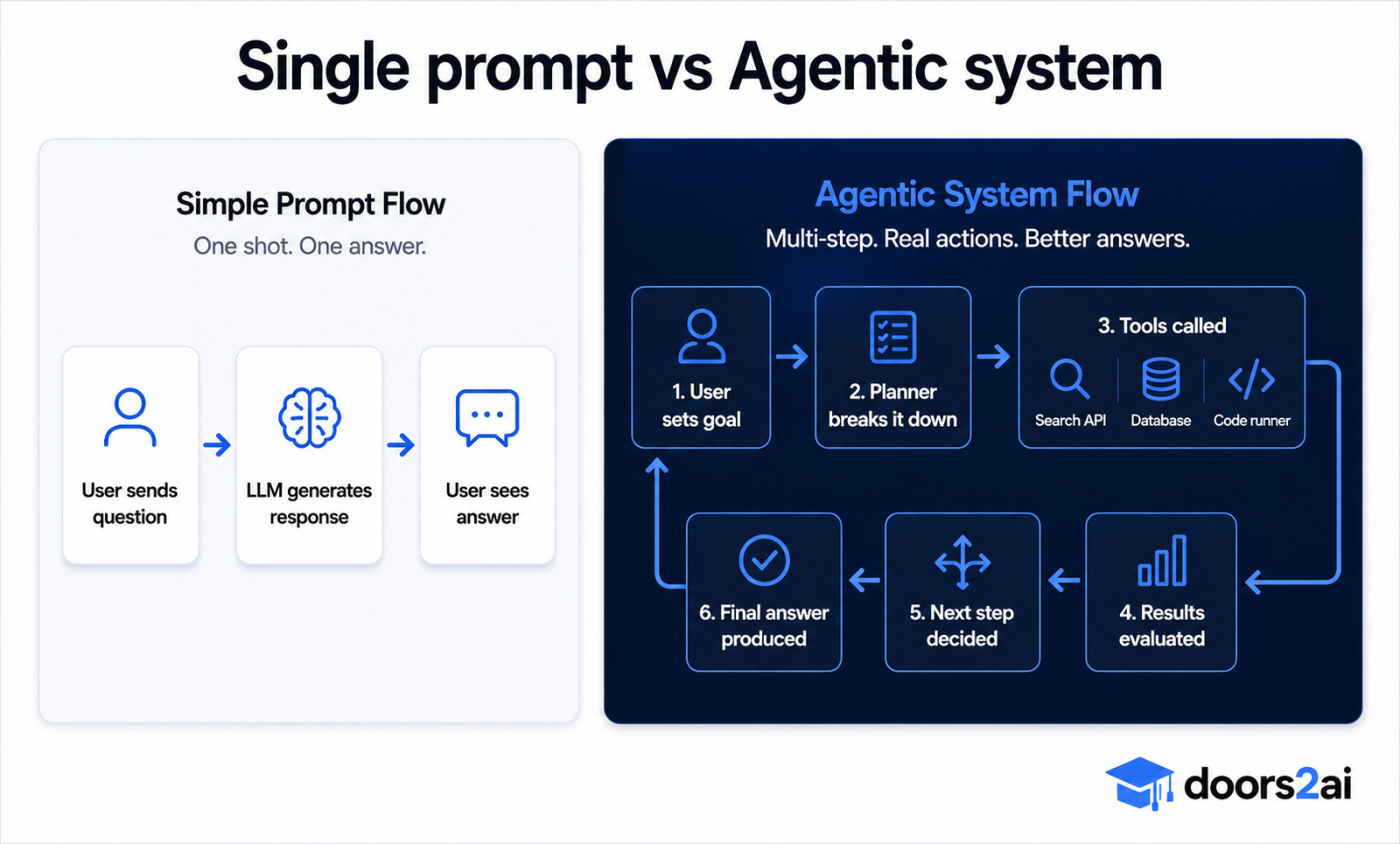
I like to think of Agentic AI as software that can plan before it acts. Instead of giving one response to one prompt, the system works through a goal in multiple steps.
An agentic system can call tools such as APIs, databases, search services, or code runners. It can look at the result, decide whether more work is needed, and continue until it has produced a useful answer or completed a task.
A simple example: if you ask a basic chatbot for the current weather in Tokyo, it may answer from old training data or say it does not know. An agentic system can call a weather API, read the result, and return a current answer.
That difference matters. Agentic AI is not only generating text. It is using real information and taking structured action inside an application.
How it differs from chatbots or simple prompts
A standard chatbot interaction is linear: the user asks a question, the model responds, and the interaction ends unless the user asks another question.
An agentic system works more like a workflow:
- The user or application defines a goal
- The system decides what steps are needed
- The system calls tools such as APIs, databases, search, or code runners
- The system evaluates what came back
- The system decides the next step
- The system produces a final output, and can retry or refine when needed
This changes how developers need to think. The LLM is no longer just a text generator attached to the edge of the product. It becomes part of the application flow, which means reliability, state, validation, and error handling matter.
Why developers should care
I do not see AI as replacing developers. I see it changing what strong developers are expected to build.
The most valuable developers in AI-era teams will not be the ones who only know how to use a chat interface. They will be the ones who understand how to design reliable AI systems: where the model fits, what tools it can use, how the workflow should run, how outputs should be validated, and how the system should recover when something fails.
That is why Agentic AI is becoming such an important skill. It sits at the intersection of software engineering, APIs, data, workflow design, and practical AI development.
Real-world examples of agentic systems
You do not need to work in a research lab to see the value of agentic systems. These patterns are already useful in practical applications:
Customer support automation
An agent can look up a customer's account, check policy rules, apply a refund if allowed, and send a confirmation.
Research assistants
An agent can search sources, read and summarise information, and produce a structured report with references.
Code review tools
An agent can review a pull request, identify possible issues, suggest fixes, and explain the reasoning.
Data processing pipelines
An agent can read incoming data, classify it, route it to the right system, and generate a summary.
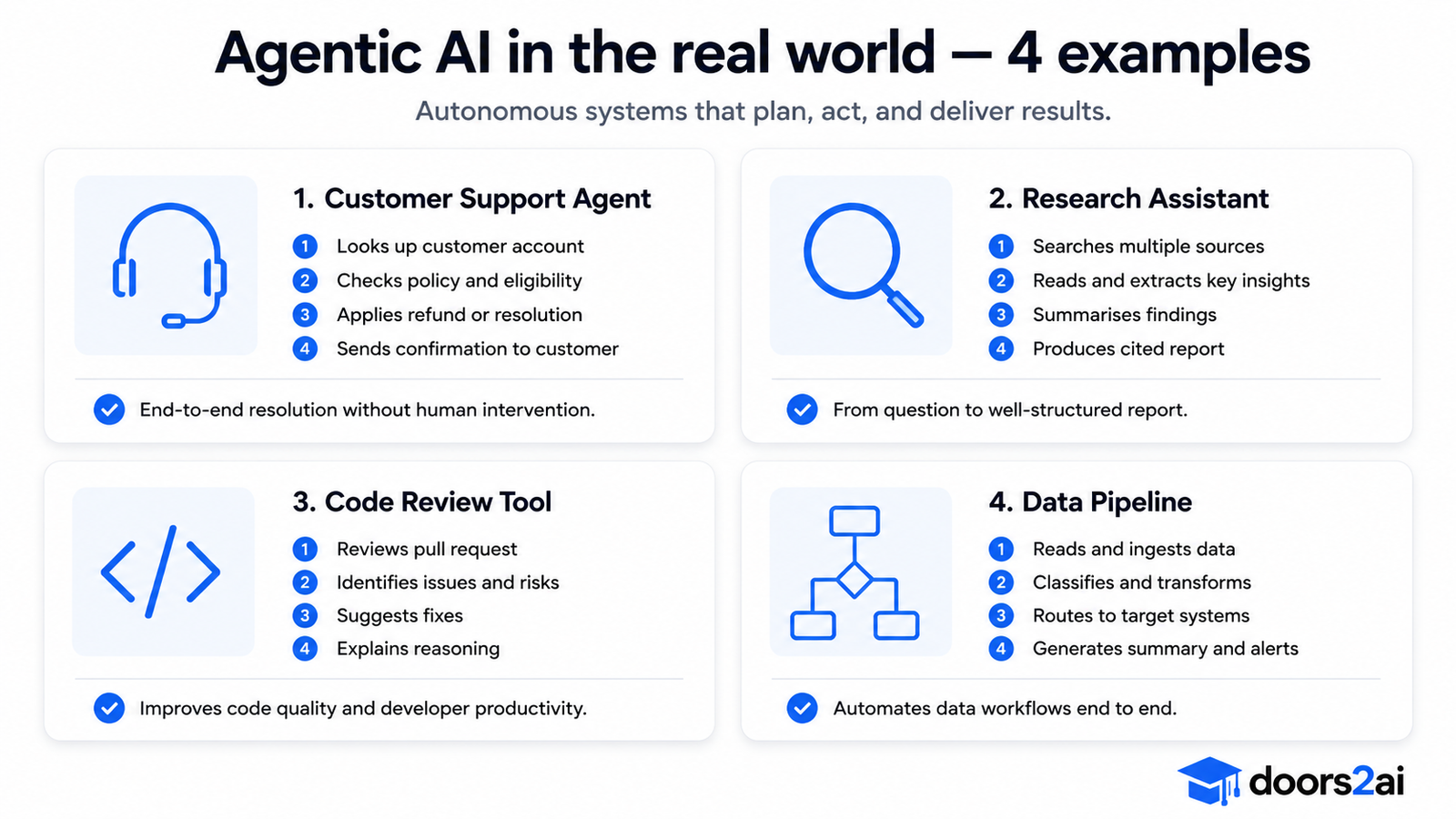
What these examples have in common is workflow. The AI is not simply answering a question. It is following a sequence, using tools, and making decisions along the way.
Skills developers should start building
Jumping straight into agents before you understand the foundation. Build these skills in order instead.
LLM foundations
Understand how language models behave in practical applications. Learn context windows, temperature, model selection, hallucinations, and why outputs are probabilistic.
APIs and tool use
Agentic systems usually depend on APIs. Developers need to understand HTTP, REST, authentication, request/response flows, and structured error handling.
Prompt engineering for reliability
In agentic systems, prompts must be clear, structured, and consistent. The goal is not only a good answer; the goal is a predictable output the application can use.
AI workflows and orchestration
Tools like LangChain and LangGraph help developers build multi-step workflows with state, branching, retries, and tool integration. This is where agentic development becomes real software engineering.
Evaluation and guardrails
AI systems need validation. That may include JSON schemas, confidence checks, human review, retry logic, or business rules that prevent unsafe or incorrect actions.
Why this skill will become more valuable
Agentic AI will become more valuable because the easy part of AI is becoming commoditised. Anyone can call an LLM. The real skill is building useful, reliable workflows around it.
Simple chat interfaces are no longer a strong differentiator. The applications that create business value usually need real data, tool use, decision points, retries, and explainable outputs. That is exactly where agentic patterns fit.
This is also why software engineering fundamentals still matter. The better you understand APIs, databases, backend design, and system behaviour, the better you will be at building AI applications that work beyond a demo.
Key takeaways
- Agentic AI is about multi-step action, not just single-prompt responses.
- The LLM becomes part of the application workflow, not just a text generator.
- APIs, tools, databases, and validation are central to building agentic systems.
- LangChain and LangGraph are useful once the software engineering foundation is clear.
- The most valuable developers will know how to make AI systems reliable, not just impressive.
Final thoughts
Agentic AI is not a buzzword I would chase blindly. It is a natural next step in how AI becomes part of real software: from one-shot answers to structured workflows that can complete meaningful tasks.
My advice is simple: start small. Learn LLM basics, get comfortable with APIs, then build a small workflow that uses one or two tools. Once that works, add state, validation, and error handling.
The developers who learn this now will not just use AI better. They will be able to build a new class of applications that were difficult to create only a few years ago.
If you want to learn AI application development in a structured, practical way, the doors2ai AI Application Development path covers LLM foundations, RAG, LangChain, LangGraph, and multi-agent systems — built around real projects and live instruction.